Colonial Families of the United States of America Volume V
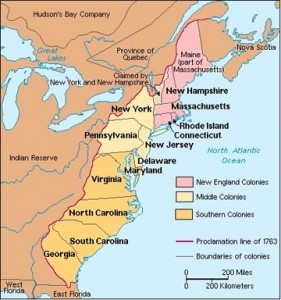
The American Revolution unfolded in 13 British colonies amassed the eastern coastline of North America. These 13 colonies were explored, settled and colonised over more a century, offset in 1607 (Virginia) and concluding in 1732 (Georgia). To sympathize the causes of the American Revolution requires an understanding of the xiii colonies and their development and experiences in the colonial period, specially their relationship with U.k..
Motives for colonisation
Each of the 13 British colonies in America began with a land claim, followed by exploration and settlement by a British visitor or expedition grouping. The principal factor behind the British colonisation of America was gold. Like the Castilian in South America, British explorers and settlers hoped to find big deposits of gilt or other precious minerals.
When large gold deposits could not be found, country and natural resources replaced golden as an incentive for colonisation, settlement and migration. Available land was extremely scarce in Europe because it was monopolised by wealthy royals and aristocrats. Information technology was far more abundant in the New World, allowing settlers to become freeholders or yeoman farmers rather than mere tenants.
The abundance of raw materials in North America was some other potential source of turn a profit. Timber, rice, grain, tobacco, cotton wool, indigo, furs, fish and other bolt could be harvested or grown in abundance in America. The availability of tall timber provided the materials for the colonial shipbuilding industry. Later, the discovery of iron ore encouraged the germination of local ironworking foundries.
Population
Over time, the 13 colonies were populated with Europeans and slaves imported from Africa. Immigration increased steadily in the 17th and 18th centuries. In 1640, at that place were fewer than 25,000 Europeans in British America. This increased to more seventy,000 by 1660 and around 150,000 in 1680. By the outbreak of the French and Indian War in 1754, the European population was approaching two 1000000.
Working-class Europeans arriving in the New World establish life there more prosperous and comfortable. Farming land was readily available, nutrient was plentiful and living standards were ameliorate than those of Europe.
Immigration continued speedily, fifty-fifty at the pinnacle of the Revolutionary War. In addition to European population growth, well-nigh 300,000 African-American slaves were landed in the British colonies betwixt 1620 and the outbreak of the revolution in 1765. Some other half-million people arrived in British America equally indentured servants.
Common heritage
Every bit part of the British Empire, the xiii colonies shared some common heritage, attitudes and institutions. Because of this – and because they afterwards joined together in revolution – many think of these colonies as a unified and homogenous group. This was far from the example.
All 13 colonies were marked past differences in geography, climate, natural resources, population, economic production and how they were governed. Intercolonial tensions were not uncommon and were commonly fuelled by disputes over trade, borders and state claims.
Despite these differences and tensions, the British colonies in America were generally seen as a place of hope, opportunity and potential prosperity. The colonies' biggest advantage was their distance from Europe and freedom from old European hierarchies and systems of power. The botanist John Bartram, who travelled extensively throughout the region, wrote of the British colonies in 1751:
"England already has an uninterrupted line of well-peopled provinces on the coast, successively begun within less than 150 years. Every year they are augmented by an accession of subjects, excited by the desire of living under governments and laws formed on the almost excellent model upon world. In vain practise we look for an equal prosperity among the plantations of other European nations… This surprising increment of people is a foundation that will deport a mighty superstructure."
Economics and production
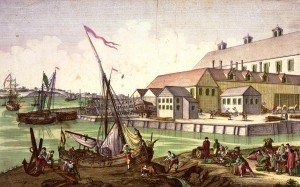
The economies of British America were focused importantly on agriculture and master production. The vast bulk of colonists lived in rural and provincial areas and worked on plantations, farms or harvesting natural resources.
Though agronomics was ascendant across all 13 colonies, there was considerable variation from region to region. In New England, the six northernmost colonies, fix and whale oil made up well-nigh half of exports, with fur, leather, timber and livestock also traded heavily. The more than temperate weather in the Centre Colonies meant food grains constituted almost three-quarters of exports, while in the Due south, tobacco and rice made up almost seventy% of appurtenances exported.
Manufacturing grew considerably through the 1700s but was largely confined to pocket-size enterprises. British mercantilist legislation like the Iron Human action (1750) discouraged or prohibited the formation of large operations that could rival or replace British companies. Many secondary goods such as wear, furniture, machinery and weapons were still imported from England.
Life in the colonies
This lack of major industries meant American cities remained comparatively small. The majority of colonists lived in minor communities, towns, villages or on the frontier. Distances, poor roads and the fright of native attacks meant that few travelled far from their hometown.
This meant that most colonists lived relatively independent lives removed from the control or interference of governments, both their own colonial assemblies and the parliament in London. As mentioned above, living standards were more often than not superior to Europe. This led to improvements in education and literacy, which was much higher in colonial America than in Europe (upwardly to 85 per cent in some places).
In general, Americans did not retrieve themselves "Americans"; they were withal to develop any sense of nationalism or American identity. Instead, most considered themselves British subjects and natives of their colony (Virginians, Southward Carolinians, Marylanders and so forth).
Foreign neighbours
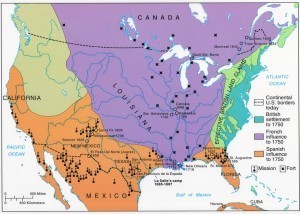
The thirteen British colonies were non alone on the continent. Three other European powers laid merits to territory in North America and shared borders with the British.
The Spanish were the get-go to arrive in North America, post-obit Christopher Columbus' famous expedition that 'discovered' North America in 1492. The French began exploring the continent in 1524 and, past the end of the century, were attempting permanent settlements.
The Dutch also commissioned exploration of the North American coastline (1609) and initiated settlements 14 years later. By 1660, the Dutch controlled the area now occupied past New Jersey and eastern New York state. They surrendered their American colonies to England in 1667, subsequently defeat in the Second Anglo-Dutch War.
By 1750, some 80 per cent of the North American continent was controlled or influenced by France or Kingdom of spain (encounter map above). Their presence was a source of tension and paranoia amid those in the 13 British colonies, who feared encirclement, invasion and the influence of Catholicism.

i. The scene of the American Revolution was thirteen British colonies that were located along the eastern seaboard of North America.
2. These colonies were founded and settled individually by British expeditions and companies, offset with Virginia (1609) and Massachusetts (1620).
3. Initially claimed in the search for gold, the colonies became a lucrative source of country and raw materials, both of which were less accessible in crowded Europe.
four. The colonies flourished in the 17th and 18th centuries. The availability of state, piece of work and resources saw increased emigration and rapid population increases, from just 55,000 in 1650 to more than than 2 million past the outbreak of the revolution.
five. Despite their growth and progress the thirteen British colonies occupied but 20 per cent of the Northward American continent. The residue was controlled or influenced by French republic and Spain. Their being contributed to political and religious tensions.
Citation data
Title: "The Thirteen Colonies"
Authors: Jennifer Llewellyn, Steve Thompson
Publisher: Alpha History
URL: https://alphahistory.com/americanrevolution/thirteen-colonies/
Engagement published: September 3, 2020
Date accessed: Feb fourteen, 2022
Copyright: The content on this page may not be republished without our limited permission. For more information on usage, delight refer to our Terms of Use.
Source: https://alphahistory.com/americanrevolution/thirteen-colonies/
0 Response to "Colonial Families of the United States of America Volume V"
Post a Comment